#23 trending2026 ED138
Rubin's Possible Dwarf Planet 2026 ED138: New Paper Says More Large Worlds May Still Be Hiding Beyond Pluto
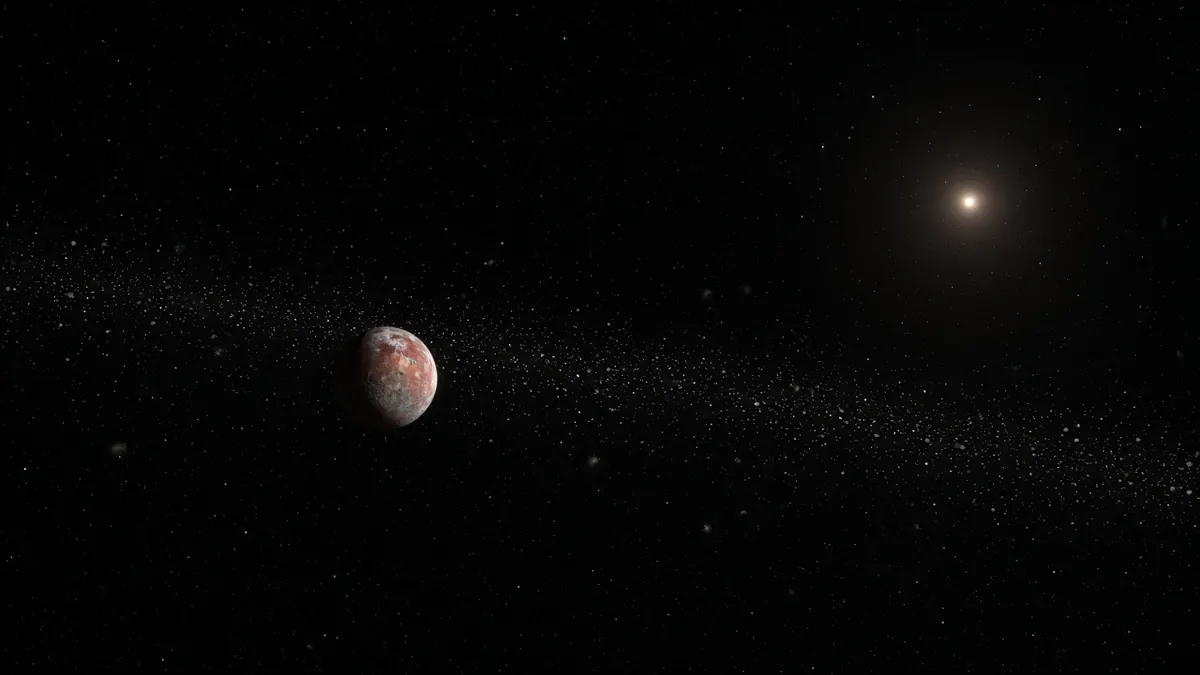
The icy world that may become the solar system’s sixth recognized dwarf planet probably isn’t the last one out there. In a research paper posted Oct. 28, the team behind 2026 ED138 lays out why the object went unnoticed for so long and estimates how many similar large bodies could still be waiting beyond Neptune.
The paper, by Matthew Holman of the Center for Astrophysics | Harvard & Smithsonian, Mario Jurić of the University of Washington and about 20 co-authors, was posted to the preprint server arXiv. Preprints have not yet gone through formal peer review.
A quick recap of the dwarf planet beyond Pluto
The NSF–DOE Vera C. Rubin Observatory found 2026 ED138 in data collected earlier this year, and the International Astronomical Union’s Minor Planet Center announced it as a dwarf planet candidate, according to the Stanford Report. It sits about 46 times as far from the sun as Earth, farther out than Pluto’s average distance of about 40, and its orbit is tilted almost 25 degrees from the plane of the solar system.
Estimates put its width between roughly 600 and 1,500 kilometers (373 to 932 miles), Scientific American reported. If confirmed, it would join Pluto, Ceres, Eris, Haumea and Makemake.
What the new paper adds
The paper fills in several details:
- Among the brightest of its kind. The authors say 2026 ED138 is one of the 10 intrinsically brightest known trans-Neptunian objects, those that orbit beyond Neptune. Only nine known objects, including Eris, Pluto, Makemake, Haumea and Sedna, appear brighter in the Minor Planet Center catalog, and whether it ranks ninth or 10th depends on which measurements are compared.
- Likely size. Its size depends on how reflective its surface is. The authors say a diameter between about 612 and 968 kilometers is the most probable range. Even the low end is above the roughly 450-kilometer size at which icy bodies are expected to be close to round, which is why it counts as a dwarf planet candidate.
- A neighbor of Haumea, but not family. Its orbit lies at the edge of a 12:7 orbital resonance with Neptune, like the dwarf planet Haumea. But the object is redder than Haumea and its known family members, so the authors conclude it is not part of Haumea’s collisional family.
- Probably no methane left. At typical reflectivity, the team’s models suggest it should have lost volatile ices like methane, nitrogen and carbon monoxide over the age of the solar system. Finding any of them would test those models.
Why wasn’t it found earlier?
The object lies far south in the sky and close to the crowded band of the Milky Way. The paper says it sat within 10 degrees of the galactic plane from 2000 to 2023, an area most earlier surveys avoided. Even Rubin’s own automatic catalogs missed it in 24 of the 38 visits whose images show it, because software not yet tuned for crowded star fields dropped sources blended with nearby stars. The team recovered those detections by measuring the images directly once the orbit was known.
Are there more possible dwarf planets?
That is the paper’s headline question. Based on how many known large objects Rubin’s search recovered, the authors estimate that about three more similar objects remain undiscovered away from the Milky Way’s plane, with a wide statistical range. They call that “probably an underestimate.”
More likely lie within 10 degrees of the galactic plane, a region the authors say no search has yet covered this deeply. Others may be on stretched-out orbits that currently keep them too far from the sun for earlier surveys to spot. A search of the plane during the first years of Rubin’s 10-year Legacy Survey of Space and Time “should find most of the remaining objects,” the authors write.
Holman struck a similar note in the observatory’s announcement: “Rubin will image the whole southern sky again and again for 10 years, so any others hiding in the places earlier surveys skipped are now within reach,” he said, as quoted by the Stanford Report.
What comes next for 2026 ED138
The paper says the object is bright enough for detailed study from the ground and by the Hubble and James Webb space telescopes. Near-infrared spectra could reveal what ices cover its surface, light curves could reveal how fast it spins, and thermal measurements could pin down its size. Because it lies toward the center of the galaxy, it will often pass in front of background stars, and those events, called occultations, could measure its size and shape directly. No timeline for those observations has been announced.
FAQ
Is 2026 ED138 officially a dwarf planet?
Not yet. It is a candidate until its size and shape are confirmed.
How many dwarf planets are there now?
The IAU recognizes five: Pluto, Ceres, Eris, Haumea and Makemake.
How many more could be out there?
The discovery team estimates about three more away from the Milky Way’s plane, and likely more near it.
Earlier coverage: Rubin Observatory Spots 2026 ED138, a Possible New Dwarf Planet Orbiting Beyond Pluto (Oct 29)