SS United States
SS United States Sinks Off Florida, Becoming the World's Largest Artificial Reef
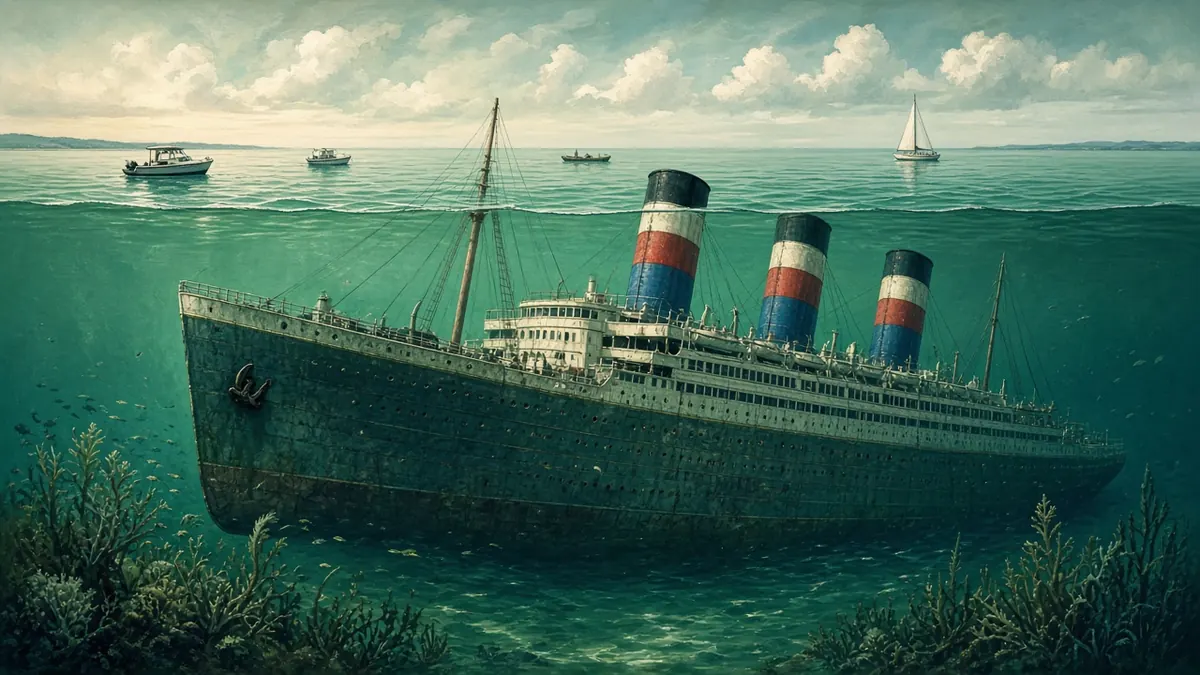
The SS United States, the ocean liner that still holds the record for the fastest transatlantic crossing by a liner, was sunk in the Gulf of Mexico on Wednesday, Nov. 11, to become the world’s largest artificial reef.
The ship was scuttled about 22 nautical miles southwest of Destin-Fort Walton Beach, Florida. An early report from MarineRadar put the moment it went under at around 1 p.m. CST, but later reporting described hours of flooding before it finally slipped below the surface later in the day. Hundreds of spectator boats gathered offshore to watch.
When did the SS United States sink?
The sinking happened on Veterans Day, a day earlier than planned. MarineRadar reported that Okaloosa County officials moved it up from Thursday because forecasts called for heavy winds.
The ship now rests in about 180 feet of water, with its upper decks roughly 55 to 60 feet below the surface. It sits near the USS Oriskany, an aircraft carrier sunk as an artificial reef in 2006.
Why are they sinking the SS United States?
After decades of failed preservation efforts, the ship’s new purpose is habitat.
- Built in 1952, the liner sat idle for about 30 years, mostly in Philadelphia, while preservation groups looked for buyers and courts weighed in, MarineRadar reported. None of those efforts worked out.
- Okaloosa County bought the 990-foot ship in 2024 to deploy it as a reef, according to Woods Hole Oceanographic Institution (WHOI).
- The goal is to expand marine habitat in the northern Gulf while supporting the region’s fishing and diving industries.
“This reef shows that recreation, conservation, and science can work together,” said Alex Fogg, natural resources chief for Destin-Fort Walton Beach, in the WHOI release.
How the ship was prepared
Before the sinking, crews at the Port of Mobile removed chemicals, wiring, plastics and glass from the ship, MarineRadar reported. WHOI said the cleanup followed best practices set by the Environmental Protection Agency, the Maritime Administration, the Army Corps of Engineers and the Gulf and Atlantic States Marine Fisheries Commission.
A living laboratory
WHOI researchers plan to study how marine life colonizes the wreck from day one. Because shipwrecks are usually found long after an ecosystem has matured, this is a rare chance to watch one form from scratch.
“This is one of the first times researchers will be able to watch an ecosystem form from scratch,” WHOI marine biologist Kirstin Meyer-Kaiser said.
According to WHOI:
- Within the first month, the team will document the ship’s condition, surrounding chemistry and early marine life.
- Researchers will take water samples from 132 locations to measure metals released as steel corrodes, such as iron, manganese and nickel.
- The team plans annual visits and hopes to start a citizen science program where recreational divers share photos.
- A separate microbe study led by Leila Hamdan of the University of Southern Mississippi will look at sediment and water around the ship.
The research is funded by NOAA and WHOI.
Was there an SS United States sinking livestream?
The reports reviewed here describe a public viewing event at a waterfront bar in Destin and hundreds of boats offshore, but they did not detail an official livestream. Check Okaloosa County or Destin-Fort Walton Beach channels for any recorded video.
FAQ
Can divers visit the SS United States reef?
The reef is designed to support diving, and the upper decks sit about 55 to 60 feet down. Check local dive operators and county guidance before planning a trip.
How big is the SS United States?
The hull is 990 feet long.
Sources
- SS United States sunk as world's largest artificial reef — MarineRadar
- Scientists are studying how ecosystems form on the world's largest artificial reef — Woods Hole Oceanographic Institution