#25 trendingMars Meteorite
Mars Meteorite Found in the Sahara Is One of the Oldest Ever: What Teghaza 001 Reveals
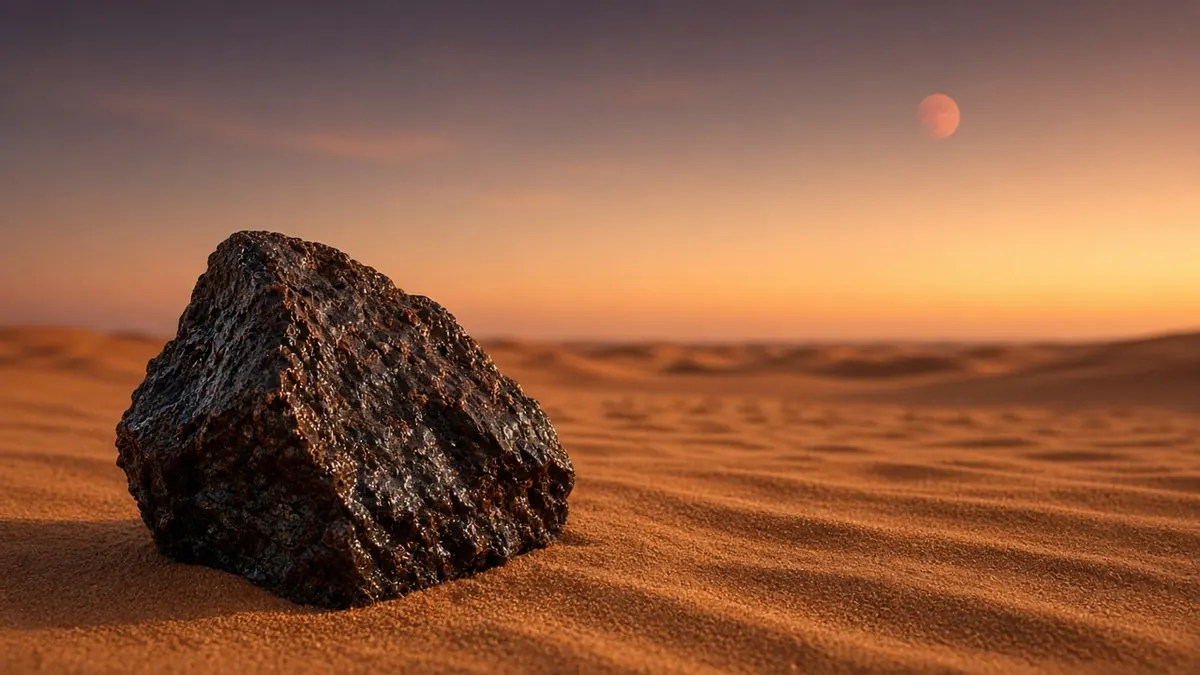
A rose-colored stone picked up in the Sahara Desert four years ago has turned out to be one of the oldest pieces of Mars ever found on Earth. In a paper published Thursday, Oct. 29, in the journal Science, NASA-funded researchers reported that the meteorite, called Teghaza 001, formed at least 4.1 billion years ago and preserves a rare record of the Red Planet’s early crust and water.
What was found in the Sahara?
The meteorite was discovered in 2022 in Mali and named after the Teghaza salt plain where it turned up, according to NASA. It weighs nearly 2 pounds (about 800 grams). At first, no one knew how old it was or exactly where it came from.
Researchers at the University of New Mexico had already identified it as Martian by matching its oxygen isotopes to those of other Mars meteorites, NASA said. Because it looked like a common type, lead author Yang Liu of NASA’s Jet Propulsion Laboratory almost passed on studying it.
“It was only after we started looking closely that we realized this meteorite is really unique,” Liu said in NASA’s announcement. “One of the paper’s reviewers called it a Rosetta Stone for Mars.”
How old is the Mars meteorite?
The team found zircon crystals inside the rock, which geologists use to date samples precisely. Smithsonian Magazine reported that the researchers used uranium-lead dating on the zircons and also analyzed rubidium and strontium, which gave a similar age estimate.
Caltech geochemist Francois Tissot’s lab dated single mineral grains on a piece smaller than a fingernail, preserving most of the sample, NASA said. The results showed that the rock was altered by Martian water about 4.1 billion years ago, which suggests it formed even earlier.
That puts Teghaza 001 among the three most ancient Martian meteorites known, out of roughly 435 identified from Mars. The others are Allan Hills 84001, which is about as old, and Northwest Africa 7034, nicknamed “Black Beauty.” NASA said Black Beauty formed about 2.1 billion years ago, while Smithsonian Magazine said it contains fragments dated at more than 4.3 billion years old.
Why scientists say it matters
The other ancient samples offer narrower glimpses of early Mars, according to NASA. Teghaza 001 holds a mix of volcanic minerals that shows how part of Mars’ crust cooled from magma and was later changed by underground water.
“This is really our first piece of Martian crust from a part of Mars we’ve never had a sample of before,” said co-author Lee Saper, now a scientist at NASA’s Ames Research Center. He added that it “records interactions of water and rock and maybe even an imprint of the Martian atmosphere as it was losing water.”
The rock’s makeup matches what NASA’s Mars Reconnaissance Orbiter has observed in the planet’s cratered southern highlands. The team identified 13 possible places on Mars where it could have come from, but NASA said no one will ever know the exact spot.
The findings add to evidence that early Mars had a more active water cycle than once thought. Saper told Reuters, as quoted by Smithsonian Magazine, that the results support the idea that early Mars had the ingredients to harbor life, but they “do not directly answer the question of whether there was life on Mars.”
What comes next
A separate paper on the meteorite’s water content was published in Science Advances in June, NASA said, and more studies are expected. “We’ve only scratched the surface,” Liu said.
Not every scientist sees it as the final word. Arya Udry, a planetary scientist at the University of Nevada, Las Vegas, who was not involved in the study, told Scientific American that because the rock’s exact origin is unknown, it is “another example of why we need to bring back samples,” Smithsonian Magazine reported.
FAQ
How did a piece of Mars end up in the Sahara?
An impact blasted it off the Martian surface, and it eventually fell to Earth. Deserts are good hunting grounds because dark rocks stand out on the barren ground, NASA said.
Is this a new discovery?
The rock was found in 2022. What’s new is the study, published Oct. 29, 2026, showing how old it is and what it reveals about early Mars.
Related topics
Sources
- NASA-funded Study Details One of Oldest Mars Meteorites Ever Found — NASA
- Rose-colored meteorite found in the Sahara Desert turns out to be 4.1 billion-year-old piece of Mars — CBS News
- This Rosy Stone Spotted in the Sahara Turned Out to Be a 4.1-Billion-Year-Old Meteorite From Mars, One of the Oldest Ever Found — Smithsonian Magazine