#18 trendingArtemis II Ionosphere
NASA's Artemis II SLS Rocket Left 'Holes' in Earth's Upper Atmosphere That Disturbed GPS, Study Finds
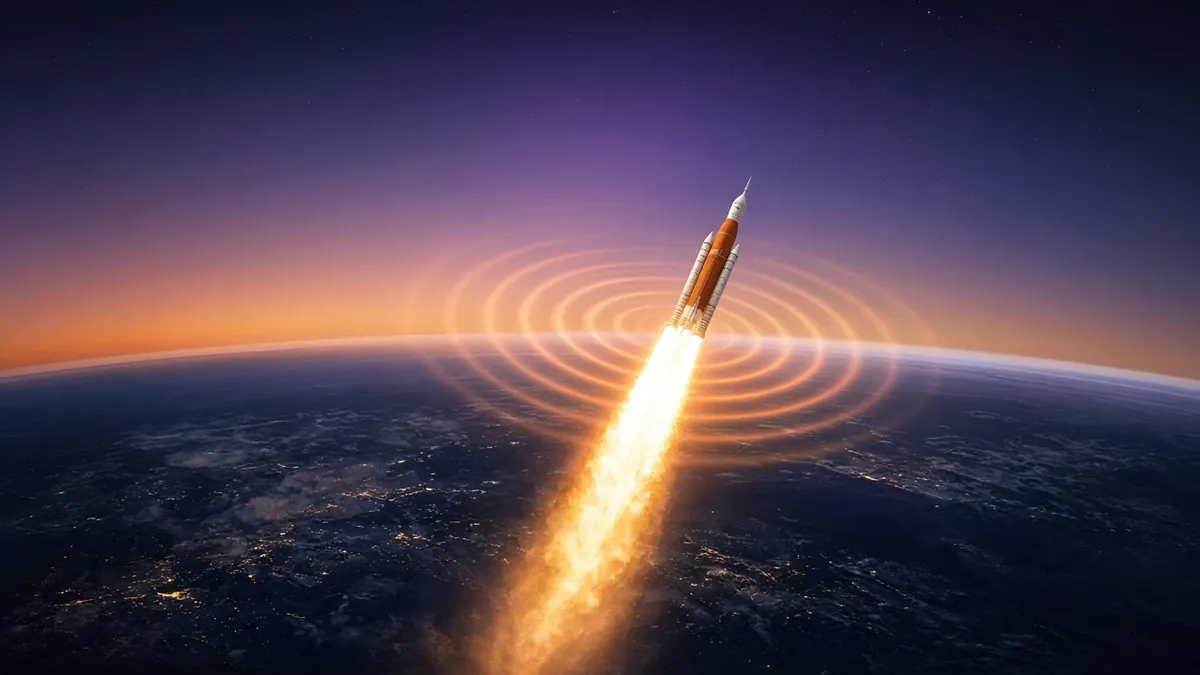
NASA’s Artemis II mission, which sent four astronauts around the moon in April 2026, left a mark on more than the history books. A new study says the Space Launch System (SLS) rocket and its upper stage disturbed Earth’s ionosphere so strongly that GPS readings on the ground could have been off by several meters.
The research, from a team at National Cheng Kung University in Taiwan, was posted as a preprint in the journal Geophysical Research Letters, according to Space.com, which first reported the findings on Nov. 4.
What did the rocket actually do to the atmosphere?
Despite the dramatic headlines, the rocket did not physically tear open the sky. As Newsweek explains, the launch and later engine burns caused a temporary drop in the concentration of charged particles (free electrons) in part of the ionosphere. Scientists call that kind of depletion an “ionosphere hole.”
The ionosphere is the electrically charged layer of Earth’s upper atmosphere, starting at altitudes above about 30 miles (50 kilometers). GPS satellites orbit far higher, around 12,550 miles (20,200 kilometers) up, so their signals must pass through this layer to reach receivers on the ground. When electron density changes, the signals arrive slightly faster or slower than expected, and position estimates drift.
According to Space.com, a rocket flying at supersonic speed creates a shock wave that “virtually punches a hole into the ionosphere.” Unlike severe solar storms, which can disrupt GPS for days, rocket-related disturbances are short-lived.
How big were the Artemis II disturbances?
The researchers reported two major “holes”:
- One left by the SLS core stage, the 212-foot (65-meter) main body of the rocket, during its climb after liftoff from Kennedy Space Center on April 1, 2026.
- One caused by two later burns of the upper stage, which took place more than an hour after liftoff at altitudes around 115 miles (185 kilometers), inside the ionosphere itself. Those burns sent the Orion capsule out of Earth orbit and toward the moon.
In both cases, the disturbances stretched across North America from east to west like giant contrails about 3,100 miles (5,000 kilometers) long, Space.com reported. Despite the raw power of the core stage, the upper-stage burns produced the more prominent disturbance.
Newsweek, describing the same preprint, reported three separate disturbances in total: one at liftoff, another about two hours later and a third more than 24 hours after launch. The difference appears to come down to how the events are counted and described, so details may shift as the paper moves through review.
The study also found the effects were larger than for any other rocket launch measured so far, and up to 10 times more intense than those seen after SpaceX’s Starship test flights, even though Starship produces roughly twice the liftoff thrust of SLS.
How did scientists measure it?
The team used networks of high-precision, fixed GPS receivers that U.S. scientific institutions operate to track tiny movements of Earth’s tectonic plates. By measuring how long GPS signals took to travel from space to these ground stations, the researchers reconstructed how the rocket’s passage changed electron concentrations overhead.
During the launch, the stations recorded electron-density changes equivalent to GPS positioning errors of several meters.
Why it matters for GPS, self-driving cars and drones
A few meters may not matter much to someone using a phone map, but it can matter to automated systems. Charles Lin, an earth science professor at National Cheng Kung University and a co-author of the paper, told Space.com: “A positioning error of a couple of meters is enough to cause an autonomous car to change lanes.” He added, “It could have a strong impact not only on self-driving cars but also on drone positioning.”
The sources reviewed do not report any actual accidents or navigation failures tied to the Artemis II launch. The study describes what could have happened to positioning accuracy during the short-lived disturbances.
A new kind of space weather?
Lin said the upper-stage maneuver was the unusual part. “Rocket launches from the ground to space produce that kind of effect, but we have never seen this kind of orbital maneuver in an interplanetary mission,” he told Space.com. “In the future, as we are going to see many more missions going to the moon and to Mars, these space weather effects will become much more significant.”
That matters because NASA’s Artemis program aims to return astronauts to the lunar surface and build a sustained human presence on the moon, which would mean more heavy-lift launches and more high-altitude burns in the years ahead.
A quick look back at Artemis II
Artemis II was the first crewed flight of SLS and the Orion spacecraft. It carried astronauts Reid Wiseman, Victor Glover, Christina Koch and Canada’s Jeremy Hansen on the first crewed lunar flyby in more than 50 years. According to The Economic Times, the crew reached about 252,756 miles (406,771 kilometers) from Earth, beating the distance record set by Apollo 13 in 1970.
FAQ
Did the SLS rocket really put a hole in the atmosphere?
Not a physical hole. It caused a temporary depletion of charged particles in the ionosphere, which scientists call an ionosphere hole.
Is the hole still there?
No. Rocket-induced disturbances are short-lived, unlike the multi-day effects of severe solar storms.
Was anyone affected?
The study estimates GPS errors of several meters during the disturbances. The reports reviewed do not describe any specific incidents.
Has the study been peer reviewed?
It was released as a preprint in Geophysical Research Letters, so the findings may still be refined.
Sources
- NASA's Artemis II moon launch tore a hole in Earth's upper atmosphere so huge it disrupted GPS signals — Space.com
- NASA's Artemis II rocket punched 3,100-mile-long holes in Earth's atmosphere, disrupted GPS signals: Study — The Economic Times
- Artemis II tore "hole" in Earth's atmosphere, raising GPS concerns — Newsweek
- Rare reoccurring ionosphere disturbances observed during the Artemis-II Lunar flyby voyage (preprint) — ESS Open Archive