#23 trendingAntimatter
Physicists trap a single particle of antimatter for weeks, setting up a sharp new test of the Standard Model
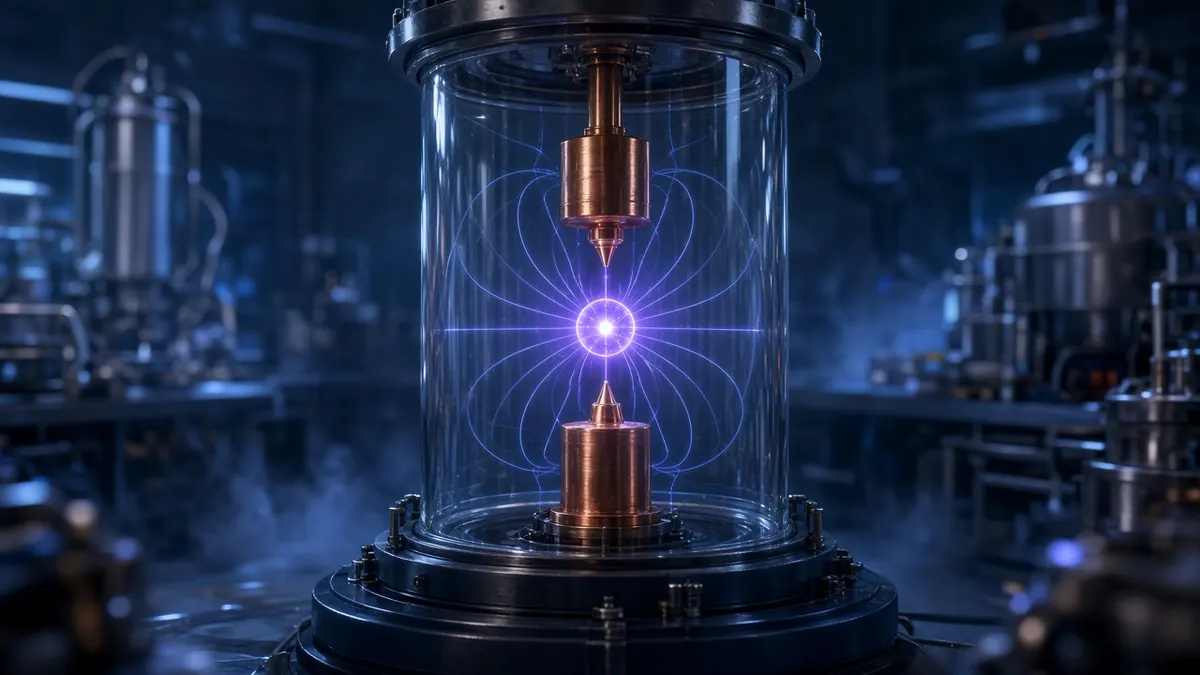
Antimatter is famous for one thing: when it touches ordinary matter, both disappear. That makes it extremely hard to study. Now a team at Northwestern University says it has caught a single particle of antimatter and kept it under precise control for weeks, a step that could set up one of the most demanding tests yet of modern physics.
The work, led by physicist Gerald Gabrielse, was published Oct. 21 in Physical Review Letters and has drawn wide attention since.
What the scientists did
The team trapped one positron, the antimatter counterpart of the electron. It has the same mass as an electron but the opposite charge.
They then cooled it so much that it settled into its lowest quantum energy state, creating what they call a “one-positron quantum cyclotron.” In that state, the particle behaves much like an artificial atom whose energy levels the researchers can control and observe, according to Northwestern.
How long the positron has been held is described slightly differently. Northwestern’s announcement says the particle has stayed trapped “for months,” while Scientific American reports that the team isolated and studied a lone positron for a month and could potentially keep doing so indefinitely.
Thomas Myers, a Ph.D. student in Gabrielse’s lab, is the paper’s first author. The National Science Foundation supported the study.
How do you hold antimatter?
You can’t put a positron in a normal container, because touching the walls would make it annihilate. “If you want to hold on to antimatter, you have to hold it in a container without walls,” Gabrielse told Scientific American.
The process, as described by the two outlets, went roughly like this:
- Make the positrons. The source is sodium-22, a radioactive isotope with a half-life of about two and a half years. When its atoms decay, they emit positrons.
- Slow them down. The fast positrons pass through a thin piece of cold tungsten, losing energy as they bounce through the crystal. Some annihilate along the way, but some make it out.
- Steer them. Electromagnetic fields guide the slowed particles along a channel.
- Trap and chill. The positron ends up in a near-perfect vacuum, held in place by electric and magnetic fields and cooled to about 0.3 degrees above absolute zero.
“We actually coaxed this very fast positron to sit there and behave for months at a time,” Gabrielse said in Northwestern’s release. He also stressed that the lab poses no hazard: “To be clear, it’s not dangerous. We don’t have enough antimatter to make an explosion.”
The team also showed it could nudge the positron between quantum states with carefully tuned microwaves and detect those jumps, a level of control needed for the precision work ahead.
Why antimatter matters
Physicists believe the Big Bang should have made equal amounts of matter and antimatter. If that had happened, the two would have wiped each other out. Yet the universe is made overwhelmingly of matter, and the Standard Model of particle physics cannot explain why.
“We know the Standard Model has to be wrong somewhere — or at least incomplete,” Gabrielse said in the university’s release.
The test ahead
The goal is to measure the positron’s magnetic moment, essentially the strength and orientation of its tiny magnetic field, and compare it with the electron’s. Using a similar setup, Gabrielse’s group previously measured the electron’s magnetic moment to about one part in 10 trillion, among the most precise measurements ever made of an elementary particle.
The Standard Model predicts that the electron and positron should be mirror images with exactly opposite magnetic moments. “If it turns out they are not equal, that would be the biggest discovery in physics in the last century,” Gabrielse said.
Roni Harnik, a theoretical physicist at Fermilab who was not involved, called it “an exciting development” in comments to Scientific American, adding that it “will enable us to test a basic symmetry.”
No result from that comparison has been reported yet. The new paper shows the trap works; the precision measurement is the next step.
FAQ
What is antimatter?
Every ordinary particle has an antimatter partner with the same mass and opposite charge. The positron is the electron’s partner. When the two meet, they annihilate.
Is trapped antimatter dangerous?
No. Gabrielse said the lab holds far too little antimatter to cause an explosion.
What did Northwestern achieve?
The team trapped a single positron near absolute zero and controlled its quantum states, something it calls a one-positron quantum cyclotron.
Has this proved the Standard Model wrong?
No. The experiment sets up a future comparison of positron and electron magnetic properties. Any mismatch would be a major finding, but no such result has been reported.
Sources
- Scientists trap and tame a single particle of antimatter for months — Northwestern Now
- Physicists trap a single antimatter particle for a month — Scientific American